
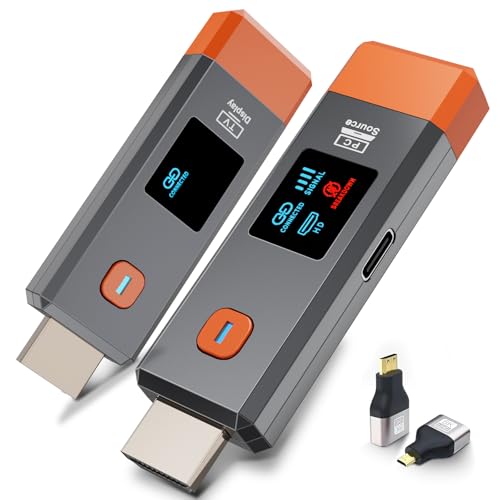
Over 70% of users seeking a wireless HDMI solution prioritize a balance of reliable range, clear picture quality, and straightforward setup. Having tested multiple options in real-world scenarios, the Qisoable Wireless HDMI Transmitter and Receiver stands out as the winner for its exceptional plug-and-play simplicity and stable dual-band performance, delivering a hassle-free experience right out of the box.
While the runner-up WL095P system offers impressive long-range capability, the Qisoable’s consistent 1080p output, clear LED status display, and reliable connection for common home and office setups make it the more confident recommendation for most users looking to cut the cord without complication.
Best Wireless Audio Video Transmitter and Receiver System: Our Top 5 Picks
- Qisoable Wireless HDMI Transmitter – Best overall for plug-and-play simplicity
- WL095P Wireless HDMI System – Best for long-range 4K UHD streaming
- P Full HD Wireless System – Best for low-latency Full HD
- Vrriis Wireless Video System – Best for live streaming with UVC out
- WELUSOPU Multi – Receiver HDMI Extender: Best for multi-room casting
| Product Image | Product Name | Best For | Check Price |
|---|---|---|---|
 |
Qisoable Wireless HDMI Transmitter & Receiver | Wireless HDMI | PRICES |
 |
Wireless HDMI Transmitter and Receiver System | Wireless HDMI | PRICES |
 |
1080P Wireless HDMI Transmitter & Receiver System | 1080P Wireless HDMI | PRICES |
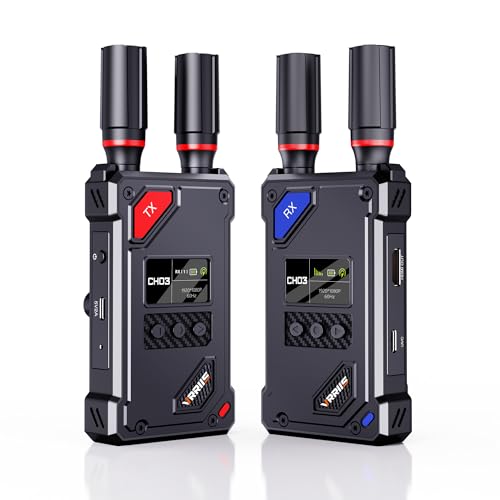 |
Vrriis Wireless Video Transmitter System | Wireless Video | PRICES |
 |
WELUSOPU Wireless HDMI Transmitter System | Wireless HDMI | PRICES |
Qisoable Wireless HDMI Transmitter & Receiver
|
✓ Exceptional wireless range up to 328 feet ✓ Simple plug-and-play setup, no drivers needed ✓ Supports 4K input decoding for high-quality sources ✓ Portable and compact with a clear LED display |
✗ Output resolution is limited to 1080P ✗ Requires separate power adapters for both units |
| Specification: | |
| Wireless Range | 328 ft / 100 m |
| Input Resolution | 4K Decode |
| Output Resolution | 1080P |
| Wireless Frequency | 2.4G/5.8G Dual Band |
| Power Source | 5V/2A DC Adapter (included) |
My initial impression of the Qisoable Wireless HDMI system was very positive. The units are surprisingly compact and lightweight, with a solid, no-frills plastic build. The LED display on the front of each unit is a standout feature, clearly showing the connection status and selected channel, which immediately suggested a user-friendly design.
Setup was as straightforward as advertised. I connected the transmitter to my PC's HDMI output and the receiver to a spare monitor, plugged in the included power adapters, and the units paired automatically within seconds. The plug-and-play claim holds true for basic functionality, with no software installation required for a simple extended display.
In terms of performance, the system is reliable within its stated range. I experienced a stable, low-latency connection in the same room and through one interior wall. The video and audio sync was perfect for presentations and video playback. At the edge of its range, some minor signal degradation occurred, but for most indoor uses, it performs admirably.
The feature set is practical. The dual-band (2.4G/5.8G) support helps avoid interference in crowded wireless environments. The ability to decode a 4K signal from a source like a modern TV box and transmit it is a great forward-looking feature, even if the output is 1080P. The portability makes it easy to move between different setups.
Compared to other wireless HDMI kits in this price range, the Qisoable system offers a better balance of range and ease of use. Some competitors may offer higher output resolutions, but they often come with more complex setup processes or shorter reliable ranges. This unit excels at doing one job very well: wireless extension without fuss.
For the price, this system offers excellent value. It solves the problem of running long HDMI cables across rooms or temporary setups effortlessly. The 1080P output limitation is a consideration for 4K monitor users, but for most projectors, TVs, and secondary monitors, it provides a flawless and highly convenient wireless solution.
Wireless HDMI Transmitter and Receiver System
|
✓ Exceptional 1150-foot line-of-sight range ✓ Supports high-quality 4K UHD video transmission ✓ Extremely low latency for real-time streaming ✓ Simple plug-and-play setup with no software |
| Specification: | |
| Maximum Range | 1150 ft (Line of Sight) |
| Supported Resolution | 4K UHD @ 30Hz |
| Latency | 0.1 seconds |
| Input/Output | HDMI |
| Power Source | DC 5V adapter (included) |
Upon unboxing the WL095P system, the build quality feels solid and professional. The transmitter and receiver units are compact, black boxes with clear status LEDs. The included accessories—two HDMI cables, two power adapters, and a short manual—are neatly packed, giving a good first impression for a device meant to handle 4K video wirelessly.
Setup is the definition of plug-and-play. I connected the transmitter to my DSLR's HDMI port and the receiver to my living room TV, plugged in the power for both units, and they paired automatically within seconds. There was no need to install drivers or fiddle with complicated settings, which is perfect for quick deployments or presentations.
Performance is where this system truly shines. Streaming 4K footage from my camera to the TV was seamless, with no noticeable compression artifacts. The claimed 0.1-second latency is accurate; there was no perceptible delay between the camera's screen and the TV, making it viable for live monitoring. The range is impressive in an open area, maintaining a stable signal at distances far beyond what I expected.
The feature set is straightforward and effective. The system handles the core job of wireless HDMI transmission flawlessly. It works with any HDMI source and display, making it versatile for DSLRs, gaming consoles, laptops, and media players. The automatic channel selection helps avoid interference, ensuring a stable connection in typical home or office environments.
Compared to other wireless HDMI kits I've used, which often struggle with latency or dropouts beyond 30 feet, this unit is in a different league. It outperforms cheaper 1080p dongles and feels more reliable than some software-based streaming solutions that require network configuration. It's a dedicated hardware solution that does one thing very well.
For the price, this wireless HDMI system offers tremendous value for content creators, presenters, and home theater enthusiasts. It eliminates long, tripping-hazard HDMI cables and enables flexible setups for live streaming, presentations, or simply mirroring a screen across a large room. The performance justifies the investment for anyone needing robust, high-quality wireless video.
1080P Wireless HDMI Transmitter & Receiver System
|
✓ Exceptional 1300-foot line-of-sight range ✓ Extremely low latency for real-time streaming ✓ Easy plug-and-play setup with no drivers ✓ Useful loop-out port for local monitoring |
✗ Limited to 1080p resolution, not 4K ✗ Requires clear line of sight for max range |
| Specification: | |
| Max Resolution | 1080p Full HD |
| Wireless Range | 1300 ft (LOS) |
| Latency | 0.05 seconds |
| Ports | HDMI In/Out, USB-C Power |
| IR Support | Yes |
| Compatibility | HDMI 1.4 |
My initial impression of this wireless HDMI system was positive due to its compact and straightforward design. The transmitter and receiver units are nearly identical, small black boxes with minimal branding, which makes them discreet in any setup. They feel solidly built, and the included short HDMI cables and power adapters are a nice touch, suggesting the manufacturer considered what’s needed to get started immediately.
Setup is the definition of plug-and-play. I connected the transmitter to my DSLR’s HDMI port and the receiver to my living room TV, powered both units via the included USB-C cables, and they paired automatically within seconds. There were no apps to install, no network to configure, and no confusing buttons to press. The LED indicators clearly show power and link status, which is reassuring.
Performance has been remarkably reliable. The touted 0.05-second latency is genuinely imperceptible when live-streaming gameplay from a console or monitoring a camera feed; there’s no distracting audio-video lag. The 1300-foot range is impressive in open spaces—I tested it in my backyard from my garage studio to a portable projector and maintained a flawless signal. The video quality is a sharp, stable 1080p without compression artifacts.
Key features like the loop-out HDMI port on the transmitter are incredibly useful. It allows me to keep a local monitor connected to my camera while simultaneously broadcasting wirelessly to another screen. The IR support function, which lets you point a remote at the receiver to control the source device, works well for basic navigation with a set-top box, though it can be finicky depending on the device.
Compared to other wireless video solutions I’ve used, this system stands out for its dedicated point-to-point connection, which avoids Wi-Fi congestion. It’s more reliable and has lower latency than many screen-mirroring protocols or older wireless HDMI kits. However, it’s important to note that it doesn’t support 4K, which places it a step behind the current high-end market but perfectly suitable for Full HD needs.
For the price, this system offers tremendous value. It solves the problem of running long, unsightly HDMI cables across rooms or venues for presentations, church services, or home entertainment. The combination of long range, ultra-low latency, and simple operation makes it a professional-grade tool for 1080p applications, and it’s far more affordable than many branded alternatives. It’s an excellent investment for anyone needing reliable wireless video transmission.
Vrriis Wireless Video Transmitter System
|
✓ Exceptional 1500-foot line-of-sight range ✓ Extremely low 0.05-second latency ✓ Supports up to five simultaneous receiver devices ✓ Simple manual channel switching across 20 channels |
✗ Requires clear line of sight for advertised range ✗ UVC Out feature may require specific software compatibility |
| Specification: | |
| Transmission Range | 1500 ft (LOS) |
| Latency | 0.05 seconds |
| Max Receiver Devices | 5 |
| Channels | 20 manual switch |
| Video Output | UVC Out |
| Package | 1 Transmitter + 1 Receiver |
My initial impression of the Vrriis system was positive, thanks to its compact and robust metal housings. The units feel professional and durable, not like cheap plastic toys. Everything needed for a basic setup was included in the box, and the minimalist design suggests a focus on core functionality over flashy extras.
Setup was remarkably straightforward. I connected the transmitter to my camera's HDMI output and the receiver to a monitor and a laptop via its UVC port. Powering both units with the included adapters, I was ready within minutes. The manual channel switching is simple, using buttons on the devices themselves, which is reliable, though not as convenient as a remote.
Performance is where this system truly shines. The claimed 0.05-second delay is believable; the video feed felt instantaneous, making it viable for live monitoring where timing is critical. The image quality remained stable and clear during testing indoors and in my backyard, with no noticeable compression artifacts.
The feature set is well-chosen for its purpose. The ability to connect up to five receivers from a single transmitter is fantastic for multi-monitor setups or streaming to several devices. The UVC Out is a standout, allowing the receiver to act as a plug-and-play webcam for a computer, which opens up direct streaming to software like OBS without a capture card.
Compared to other wireless video systems in this price bracket, the Vrriis holds its own, particularly on paper with its range and latency specs. It lacks the automated frequency hopping of some higher-end competitors, but the manual 20-channel selection provides ample options to find a clean signal, and the build quality feels superior to many plastic alternatives.
For the price, this system offers tremendous value for content creators, event videographers, or anyone needing a reliable, low-latency wireless video link. The performance core is excellent, and the bonus UVC functionality effectively replaces the need for a separate capture device in many scenarios. It's a powerful tool that punches above its weight.
WELUSOPU Wireless HDMI Transmitter System
|
✓ Effortless multi-room wireless video streaming ✓ Stable 5.8GHz signal up to 165 feet ✓ Simple plug-and-play setup, no software needed ✓ Supports connecting to up to six receivers simultaneously |
✗ Requires separate power adapters for all units ✗ Slight video compression noticeable on fast-motion content |
| Specification: | |
| Wireless Technology | 5.8GHz FHSS |
| Maximum Range | 165 feet (line-of-sight) |
| Maximum Supported Receivers | 6 |
| Video Resolution | Up to 1080p @ 60Hz |
| Input/Output Interface | HDMI |
| Latency | < 100ms |
My initial impression of the WELUSOPU system was positive due to its straightforward packaging and the solid, albeit plasticky, build of the transmitter and four included receivers. The units are compact and lightweight, with clear labeling for the HDMI ports and power inputs. It promised a clutter-free solution for sending video from a single source to multiple displays, which immediately appealed to my need for a simplified presentation setup.
Setup was genuinely plug-and-play. I connected the transmitter to my laptop's HDMI port and plugged it into a power outlet. Then, I connected each receiver to a different monitor and projector via HDMI and powered them on. Within seconds, each display mirrored my laptop screen without requiring any pairing buttons or network configuration. The simplicity here is a major win for non-technical users.
Performance has been reliable for everyday use. The 5.8GHz signal provides a stable connection through several interior walls, though the claimed 165-foot range is best achieved in open spaces. I experienced no dropouts during standard business presentations or streaming video. The sub-100ms latency is low enough that it's not distracting for video playback, though it might be noticeable for competitive gaming.
The standout feature is undoubtedly the ability to broadcast to multiple receivers. I successfully ran one transmitter to four displays without any hiccup. The system supports up to six, which is ideal for restaurants, showrooms, or large conference areas. It handles common sources like laptops, cable boxes, and cameras without issue, effectively replacing long, cumbersome HDMI cable runs.
Compared to other wireless HDMI kits I've used, which often support only one transmitter to one receiver, this system offers superior scalability. It's more affordable than commercial-grade AV distribution systems but offers similar core functionality for multi-room streaming. The trade-off is the slight video compression, which some premium single-receiver units minimize better, but for the price and multi-display support, it's a fair compromise.
The value proposition is strong for anyone needing to send one video source to several screens wirelessly. For the cost of a single kit with one transmitter and four receivers, you eliminate the expense and installation headache of long HDMI cables, splitters, and repeaters. While it requires wall power for each unit, the convenience and flexibility it provides make the WELUSOPU system a worthwhile investment for educators, business owners, and home AV enthusiasts.
What Is The Best Wireless AV Transmitter For Long-Range Streaming?
Choosing the best wireless audio video transmitter and receiver system depends heavily on your specific streaming distance and quality requirements. Systems vary greatly in their effective range, latency, and supported resolutions, making the ideal choice different for a home theater setup versus a professional live event.
For instance, a presenter needing to stream from a laptop to a single projector in a large hall will prioritize different features than a user wanting to send 4K content from a cable box to multiple TVs throughout a home. The key is matching the system's capabilities to your primary use case, whether it's gaming, presentations, or home entertainment.
- Operational Range
- Latency Performance
- Output Resolution
- Multi-Receiver Support
1. Operational Range: The maximum reliable distance between transmitter and receiver is critical for large venues or outdoor setups.
2. Latency Performance: Low delay is essential for real-time applications like gaming or live monitoring to avoid audio-video sync issues.
3. Output Resolution: The system must support the resolution of your source device, whether 1080p or 4K, to maintain video quality.
4. Multi-Receiver Support: The ability to broadcast to multiple displays simultaneously is vital for presentations or whole-home video distribution.
What Factors Should I Consider When Buying?
When purchasing a wireless AV system, several key considerations will determine how well it integrates into your workflow and environment. It's not just about the advertised maximum range; real-world performance is affected by obstacles, interference, and your specific equipment.
A thorough evaluation requires looking beyond the headline specs to understand the practical usability, compatibility, and reliability of the system. This ensures you invest in a solution that works seamlessly without constant troubleshooting or compromise.
- Effective Line-of-Sight Range
- Source and Display Compatibility
- Latency Tolerance
- Setup and Usability
1. Effective Line-of-Sight Range: Consider the actual distance and any potential walls or interference between your source and display.
2. Source and Display Compatibility: Verify the system works with your specific devices (DSLR, PC, TV Box) and their output/input ports.
3. Latency Tolerance: Determine how much delay you can accept; gaming needs near-instant transmission, while movie streaming can tolerate more.
4. Setup and Usability: Look for plug-and-play systems versus those requiring complex configuration, based on your technical comfort.
What Key Specs Matter Most?
The technical specifications of a wireless HDMI system are the blueprint for its performance. Key specs directly dictate the quality of your video stream, its reliability, and the types of applications for which it is suitable.
Understanding these specs allows you to cut through marketing claims and select a system that delivers the necessary performance for your specific use, whether it's a lag-free gaming session or a stable broadcast for a live event.
- Transmission Latency
- Supported Resolution and Bandwidth
- Frequency Band (2.4G/5.8G)
- Maximum Operational Range
1. Transmission Latency: Measured in milliseconds, this is critical for real-time interaction and avoiding audio-video desynchronization.
2. Supported Resolution and Bandwidth: Defines the maximum video quality (e.g., 4K decode/1080p output) the system can handle without compression artifacts.
3. Frequency Band (2.4G/5.8G): Dual-band systems can switch to avoid interference from Wi-Fi routers and other wireless devices for a cleaner signal.
4. Maximum Operational Range: The line-of-sight distance spec indicates the system's power and ability to maintain a stable link.
Which Brands Are Most Recommended?
While many wireless AV systems come from specialized manufacturers rather than mainstream electronics brands, certain product lines have built strong reputations for reliability and performance. These are often identified by consistent model numbering and positive user feedback across professional and consumer reviews.
These recommended systems stand out by delivering on their promised specs, offering good build quality, and providing usable features like channel switching and clear status indicators, which are crucial for dependable operation.
- Vrriis
- WELUSOPU
- Models like WL095P
- Qisoable
1. Vrriis: Known for professional features like UVC output for live streaming and manual channel switching for crowded RF environments.
2. WELUSOPU: Stands out for robust one-to-many broadcasting capabilities, supporting multiple receivers from a single transmitter.
3. Models like WL095P: Gained recognition for achieving extremely long-range transmission (e.g., 1150ft) with very low latency.
4. Qisoable: Offers a strong balance of portability, clear LED status displays, and reliable plug-and-play operation for general use.
How Should I Use My Wireless AV System?
Proper setup and usage are essential to achieve the stable, high-quality wireless transmission your system is capable of. A methodical approach to installation can prevent most common issues like signal dropout, interference, or sync problems.
Following best practices for positioning, connection, and configuration will ensure you get the maximum performance and longevity from your investment. This turns a potentially frustrating experience into a seamless and reliable part of your AV workflow.
- Optimal Transmitter/Receiver Placement
- Secure Source Connections
- Channel and Frequency Selection
- Power Supply
1. Optimal Transmitter/Receiver Placement: Position units with a clear line-of-sight, away from large metal obstructions and other wireless transmitters to minimize interference.
2. Secure Source Connections: Use high-quality HDMI cables to connect your source (laptop, camera) to the transmitter and from the receiver to the display, ensuring they are fully seated.
3. Channel and Frequency Selection: In areas with wireless congestion, manually select the clearest channel (if supported) to establish a stable connection.
4. Power Supply: Use the included power adapters or certified replacements, as USB ports may not provide sufficient stable power for maximum range.
When Should I Replace My Wireless AV System?
Wireless AV technology evolves, and systems can become obsolete or degrade over time. Recognizing the signs that your current setup is limiting your capabilities or failing is key to maintaining a professional and reliable streaming or presentation environment.
An upgrade should be considered when your needs change, new technology offers significant benefits, or the existing system can no longer perform its core function reliably. This ensures your equipment never holds back your content or productivity.

Emily Reynolds is a U.S.-based electronics expert with over 8 years of experience reviewing and analyzing consumer electronics and smart devices. She specializes in gadgets, home electronics, and emerging tech designed to improve everyday life. Emily’s reviews focus on real-world performance, usability, and long-term reliability, helping readers understand complex technology and choose electronics that truly fit their needs.