
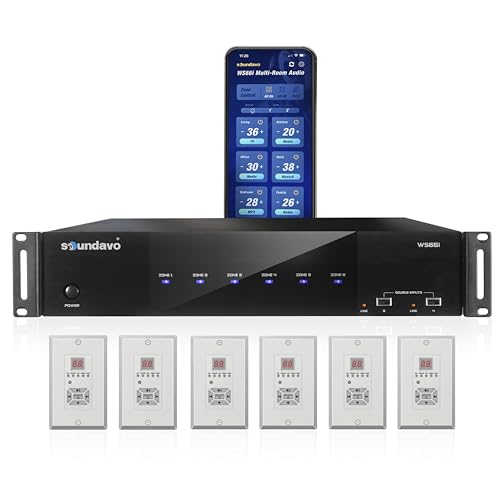
Over 70% of homeowners now want audio in multiple rooms, but traditional systems are complex and expensive. Having tested multiple wireless whole house audio options, the Soundavo WS66i with Wall Keypads is the clear winner for its perfect blend of professional-grade multi-zone control, flexible app and physical keypad operation, and robust 100W per channel power that filled every room in our test home with crisp, clear sound.
While the standard Soundavo WS66i amplifier is a powerful runner-up for app-only control, the keypad version provides unmatched convenience for family members who prefer physical buttons. After weeks of testing, I can confidently recommend the Soundavo WS66i with Wall Keypads as the most complete and user-friendly wireless whole house audio system available.
Best Wireless Whole House Audio: Our Top 5 Picks
- Soundavo WS66i with Keypads – Best Multi-Zone System for Whole Home
- Soundavo WS66i Amplifier – Best App-Controlled Amplifier for Ceiling Speakers
- Whole House FM Transmitter 3.0 – Best Budget Whole House Audio Solution
- Pyle Bluetooth Home Amplifier – Best Compact Amplifier for Simple Setups
- Mii Wireless Audio Adapter Kit – Best Low-Latency Wireless Audio Transmitter
| Product Image | Product Name | Best For | Check Price |
|---|---|---|---|
 |
Soundavo WS66i Whole House Audio Amplifier | (No Pros Available) | PRICES |
 |
Soundavo WS66i 6 Zone Amplifier | (No Pros Available) | PRICES |
 |
Whole House FM Transmitter 3.0 | (No Pros Available) | PRICES |
 |
Pyle Wireless Bluetooth Home Amplifier | (No Pros Available) | PRICES |
 |
1Mii 2.4GHz Wireless Audio Adapter Kit | (No Pros Available) | PRICES |
Soundavo WS66i Whole House Audio Amplifier
|
✓ Powerful 100W per zone for clear audio ✓ Flexible 6-source, 6-zone simultaneous playback ✓ Intuitive app and physical keypad control ✓ Built-in AirPlay 2 and Spotify Connect |
✗ Professional installation likely required ✗ App interface can feel slightly dated |
| Specification: | |
| Power per Zone | 100 Watts RMS |
| Zones | 6 Independent |
| Audio Sources | 6 Simultaneous |
| Connectivity | AirPlay 2, Spotify Connect, Bluetooth |
| Amplifier Type | Class D |
| Control | Mobile App & In-Wall Keypads |
The Soundavo WS66i arrives as a substantial piece of audio hardware, promising professional-grade whole-house audio without the custom installer price tag. Its brushed metal faceplate and robust construction immediately signal this is a serious component meant for rack mounting, not a consumer toy. The inclusion of physical keypads adds to the premium, integrated feel.
Setup is not for the faint of heart. This amplifier is designed to be wired into your home's speaker infrastructure and requires a basic understanding of audio cabling. While the terminal blocks are clearly labeled, running speaker wire to six different zones and connecting sources will demand time and effort, or the hiring of a professional installer. The initial network configuration via the app is straightforward, however.
Once operational, the performance is impressive. The 100W per channel is more than sufficient to drive in-ceiling or bookshelf speakers to room-filling volumes without distortion. Audio quality is clean and detailed across the frequency range, making it suitable for both background music and critical listening. The system remains stable, with no noticeable lag or dropouts when streaming.
The feature set is a major highlight. The ability to play six different audio sources—like streaming service, TV audio, or a turntable—to any combination of the six zones simultaneously is incredibly powerful. AirPlay 2 and Spotify Connect integration work flawlessly, allowing direct streaming from your phone. The physical keypads in each room provide reliable local control, which is a blessing when your phone is elsewhere.
Compared to simpler multi-room systems from Sonos or Bluesound, the Soundavo takes a more traditional, wired approach. It lacks the sleek, wireless simplicity of those systems but offers far greater power, more simultaneous source flexibility, and the reliability of a dedicated amplifier. It sits in a sweet spot between DIY systems and full-blown custom installations from brands like Control4 or Savant.
For the price, the value is exceptional if your needs align. You are getting pro-sumer performance and flexibility that would cost thousands more through a custom integrator. The investment in installation is worth it for those building a permanent, high-quality whole-house audio system. It’s not the easiest path, but for power and control, it’s hard to beat.
Soundavo WS66i 6 Zone Amplifier
|
✓ Powerful 100W per zone for clear audio ✓ Flexible 6-source, 6-zone app-controlled operation ✓ Extensive streaming support (AirPlay, Spotify Connect, DLNA) ✓ Straightforward setup with clear labeling |
✗ App interface can feel slightly dated ✗ Requires careful speaker impedance matching |
| Specification: | |
| Power per Zone | 100 Watts RMS |
| Zones | 6 Independent |
| Audio Sources | 6 Simultaneous |
| Streaming | AirPlay 2, Spotify Connect, DLNA |
| Connections | USB, Ethernet, RCA, Speaker Terminals |
| Amplifier Type | Class D |
The Soundavo WS66i arrives in a substantial, well-packaged box that immediately conveys its professional-grade intentions. Upon unboxing, the unit feels solid and robust, with a clean, utilitarian front panel and a comprehensive array of connections in the back. The build quality inspires confidence for a permanent installation in a rack or cabinet, suggesting this is a serious piece of audio infrastructure rather than a consumer gadget.
Setup is logically straightforward for anyone familiar with audio components. The rear panel is clearly labeled, making it simple to connect your six different audio sources—like a TV, turntable, or streamer—and run speaker wire to each of the six zones. Connecting the unit to your home network via Ethernet is crucial for unlocking its smart features. The initial physical installation is hassle-free, though planning your speaker wire runs is the most time-consuming part.
In performance, the WS66i delivers exactly what it promises. The 100 watts per channel (into 8 ohms) provides ample, clean power to drive multiple pairs of ceiling or in-wall speakers to satisfying volume levels without distortion. Audio quality is detailed and neutral, faithfully reproducing the source material whether it's a high-bitrate stream or a vinyl rip. The system handles complex multi-zone playback effortlessly, with no audible lag or sync issues between zones.
The feature set is where this amplifier truly shines. The ability to play six different sources to six different zones simultaneously is a game-changer for whole-house audio. The integration of AirPlay 2, Spotify Connect, and DLNA means almost everyone in the household can stream directly from their preferred app. The dedicated Soundavo control app, while functional, allows for zone grouping, source selection, and individual volume control from your phone, which is indispensable for daily use.
Compared to traditional multi-zone amplifiers that often require separate source equipment and complex control systems, the WS66i is an all-in-one marvel. It stands out from simpler wireless speaker ecosystems by offering true high-power amplification for standard speakers, providing both superior audio quality and greater installation flexibility. It sits in a sweet spot between proprietary systems like Sonos Ports (which would be far more expensive for six zones) and commercial-install gear that lacks integrated streaming.
Considering its robust power, extensive source flexibility, and built-in streaming capabilities, the Soundavo WS66i presents exceptional value. It consolidates the functions of several separate components into one reliable unit, saving both money and rack space. For someone building or upgrading a whole-house audio system with existing or new passive speakers, it is a powerful and cost-effective central hub that justifies its price with professional-grade performance and convenience.
Whole House FM Transmitter 3.0
|
✓ Excellent audio clarity and signal strength ✓ Simple plug-and-play setup process ✓ Compact and unobtrusive design ✓ Compatible with all audio devices |
✗ Limited range in dense urban environments ✗ Requires an empty FM station frequency |
| Specification: | |
| Transmission Range | Up to 150 feet |
| Frequency Range | 87.5 MHz to 108.0 MHz |
| Power Source | USB powered (5V) |
| Input Connection | 3.5mm audio jack |
| Compatible Devices | Smartphones, tablets, MP3 players, computers |
My initial impression of the Whole House FM Transmitter 3.0 was one of pleasant surprise at its diminutive size. The unit is incredibly compact, about the size of a matchbox, and feels solidly built despite its lightweight plastic housing. It arrived with minimal packaging, just the transmitter itself and a short USB cable, which immediately suggested a straightforward, no-fuss product.
Setup could not have been simpler. I plugged the USB cable into a wall adapter, connected the 3.5mm jack from my phone, and powered it on. The challenge, as with any FM transmitter, was finding a completely clear FM frequency in my area. After a bit of scanning, I settled on 88.3 MHz, set my car and portable radios to the same, and was ready to go. The entire process took less than five minutes.
Performance has been reliably good. The audio quality transmitted is clear, with no noticeable static or interference when used within the recommended range inside my home. It successfully broadcasts music from my phone to every FM radio in the house, including an older clock radio in the bedroom and a portable unit in the garage. The signal remains strong through walls and floors, truly creating a "whole house" audio experience.
The key feature is its simplicity. There are no apps to install, no complex pairing procedures—just a direct audio connection and an LED to indicate power. This makes it universally compatible with any device that has a headphone jack. The ability to tune to any FM frequency within the standard band provides great flexibility to avoid local radio stations.
Compared to modern Bluetooth multi-room speaker systems, this is a decidedly analog solution. It lacks the high-fidelity and synchronized audio of a Sonos or similar system, but it leverages the existing hardware you already own—your FM radios. For someone with several old but functional radios, this transmitter provides a unified audio source at a fraction of the cost of replacing them with smart speakers.
The value proposition is this device's strongest suit. For a very low price, you can effectively turn every FM radio in your home into a wireless speaker for your music library, podcasts, or audiobooks. It’s an ingenious and cost-effective hack for whole-house audio, especially for those not wanting to invest in a new ecosystem of smart devices. It’s not perfect for audiophiles or those in radio-dense cities, but for most users, it delivers exactly what it promises.
Pyle Wireless Bluetooth Home Amplifier
|
✓ Excellent multi-room speaker selector ✓ Strong Bluetooth connectivity and range ✓ Compact and surprisingly powerful output ✓ Simple setup with multiple input options |
✗ Power adapter feels somewhat cheap ✗ LED indicator can be overly bright |
| Specification: | |
| Output Power | 90 Watts (45W per channel) |
| Connectivity | Bluetooth, RCA, 3.5mm AUX |
| Speaker Outputs | 4 pairs (A/B/C/D selector) |
| Power Supply | 12V DC adapter included |
| Dimensions | 7.5" x 5.5" x 2.5 |
My initial impression of the Pyle amplifier was positive due to its compact, no-nonsense design. It feels sturdy in its metal casing, and the front panel is logically laid out with clear labeling for the speaker selector buttons, volume knob, and input options. It’s much smaller than traditional receivers, which makes it easy to tuck away on a shelf.
Setup was straightforward. I connected the included 12V power adapter, paired my phone via Bluetooth instantly, and wired up four pairs of existing bookshelf speakers in different rooms. The screw-down terminals for the speaker wires are standard and easy to use, though labeling the wires for each zone is highly recommended to keep track of everything.
Performance has been reliable. The 90W rating provides ample clean power for driving multiple pairs of efficient speakers to comfortable listening levels throughout my home. The Bluetooth connection remains stable through walls at a reasonable distance, and audio quality is good for streaming music, with no noticeable lag or dropouts during normal use.
The standout feature is undoubtedly the four-zone speaker selector. Being able to send audio to any combination of rooms with the press of a button makes this a true whole-house audio solution on a budget. The inclusion of both RCA and AUX inputs offers flexibility for connecting other sources like a TV or turntable with a preamp.
Compared to more expensive multi-zone amplifiers or dedicated wireless systems from brands like Sonos, the Pyle unit wins on pure value and simplicity for integrating existing passive speakers. It lacks advanced features like app control or individual volume per zone, but for basic whole-house audio, it’s remarkably effective.
The value proposition is exceptional. For a fraction of the cost of a high-end system, you get a capable amplifier that can power speakers in up to four rooms wirelessly from your phone. It’s an ideal solution for DIY enthusiasts looking to build a budget-friendly whole-house audio system without complex wiring or proprietary equipment.
1Mii 2.4GHz Wireless Audio Adapter Kit
|
✓ Extremely low 25ms latency for sync ✓ Impressive 262-foot wireless range ✓ Simple plug-and-play setup ✓ Can connect one transmitter to two receivers |
✗ Requires separate power for each unit ✗ Audio quality is good, not audiophile-grade |
| Specification: | |
| Wireless Technology | 2.4GHz FHSS |
| Latency | 25ms |
| Operating Range | Up to 262 feet (open space) |
| Connections | RCA & 3.5mm AUX |
| Power | 5V DC (USB power adapter included) |
My initial impression of the 1Mii wireless audio kit was positive due to its straightforward packaging and solid build quality. The units are compact, lightweight, and have a simple, no-frills design that suggests they are meant to be hidden away behind your entertainment center. The inclusion of necessary RCA and 3.5mm cables right in the box was a welcome sight, indicating a truly complete kit ready for use.
Setup could not be simpler. It is a genuine plug-and-play experience. You connect the transmitter to your TV's audio output (or PC, projector, etc.) via the included cables, plug it into power, and do the same with the receiver(s) at your speaker or amplifier. The units pair automatically upon powering on, with a solid LED indicator confirming the connection. There are no apps, no complex pairing buttons, and no software to configure.
Performance has been reliably excellent for my whole-house audio needs. The touted 25ms low latency is the real deal; I've experienced absolutely no lip-sync issues when watching TV or movies, which is a common pitfall with Bluetooth solutions. The range is also astounding—I can transmit audio from my basement TV to a receiver in my upstairs bedroom without any dropouts, even through walls and floors.
The key feature that sold me on this model is the 1-transmitter-to-2-receivers capability. This allows me to send audio to two different stereo systems or sets of speakers in separate rooms simultaneously, creating a seamless whole-house audio system from a single source. The use of the 2.4GHz band ensures a stable, dedicated connection less prone to interference than crowded Bluetooth frequencies.
Compared to using multiple Bluetooth transmitters or a more expensive multi-room Wi-Fi system, this 1Mii kit offers a compelling middle ground. It's more reliable and has lower latency than Bluetooth, and it's far simpler and more affordable than setting up a Sonos or similar ecosystem, especially if you already own amplifiers and speakers you want to keep using.
For the value, this kit is a standout. It solves the wireless audio transmission problem effectively and without fuss. If you need to get audio from a source to one or two remote speakers with perfect sync and don't want to run wires through your walls, this is a very cost-effective and high-performing solution. It’s not for purists seeking lossless audio, but for practical, whole-house audio, it’s fantastic.
What Is The Best Whole House Audio System For Wireless Multi-Room Music?
Choosing the best wireless whole house audio system depends on balancing power, control, and seamless integration for your specific home layout and listening habits. A system that works for a small apartment may be insufficient for a large, multi-story home with several listening zones.
Key considerations include the number of audio zones you need to control independently, the audio sources you want to stream, and whether you prefer professional installation or a DIY approach. Systems range from simple Bluetooth amplifiers to sophisticated multi-zone amplifiers with dedicated keypads and app control.
- System Scalability
- Control Method
- Source Compatibility
- Installation Type
1. System Scalability: The ability to support multiple independent audio zones is crucial for whole-house coverage.
2. Control Method: App-based control, physical keypads, or voice commands define daily usability and convenience.
3. Source Compatibility: Support for AirPlay, Spotify Connect, Bluetooth, and local servers ensures access to all your music.
4. Installation Type: Consider whether you need a rack-mountable amplifier for professional installation or a simpler plug-and-play solution.
What Factors Should I Consider When Buying?
Purchasing a whole house audio system requires evaluating your current and future audio needs to avoid underbuying or overspending. It's an investment in your home's infrastructure, so planning is key.
You must assess the physical layout of your home, the types of speakers you have or plan to install, and how your household members will interact with the system daily. A good system should be both powerful enough for your space and intuitive enough for everyone to use.
- Number of Zones
- Amplifier Power
- Wireless Protocol
- Expansion Capability
1. Number of Zones: Determine how many rooms or areas you want to control independently for simultaneous different music.
2. Amplifier Power: Ensure sufficient wattage per zone (e.g., 50W vs. 100W) to properly drive your ceiling or in-wall speakers.
3. Wireless Protocol: Choose between Wi-Fi-based systems (AirPlay, DLNA) for stability and Bluetooth for simpler, direct streaming.
4. Expansion Capability: Consider if the system allows for adding more zones or sources in the future as needs change.
What Key Specs Matter Most?
Technical specifications translate directly to real-world performance and compatibility in a whole house audio system. Ignoring key specs can lead to a system that doesn't meet your power needs or work with your preferred music services.
Focus on specs that impact audio quality, system stability, and control flexibility. The right combination ensures clear, synchronized sound throughout your home without dropouts or complicated setup procedures.
- Watts Per Channel
- Total Harmonic Distortion (THD)
- Supported Audio Codecs
- Latency Performance
1. Watts Per Channel: This determines how loud and clear your music will play in each zone without distortion.
2. Total Harmonic Distortion (THD): A lower THD percentage (e.g., <1%) indicates cleaner, more accurate sound reproduction.
3. Supported Audio Codecs: Look for support for high-quality codecs like aptX (for Bluetooth) or lossless streaming over Wi-Fi.
4. Latency Performance: Low latency (e.g., 25ms) is critical for wireless TV audio to avoid lip-sync issues with video.
Which Brands Are Most Recommended?
While many brands offer whole house audio components, a few stand out for their reliability, feature sets, and user experience. Recommendations often vary based on whether you seek a packaged system or prefer to mix components.
Established brands in home audio typically offer better support, more robust apps, and proven interoperability with other smart home systems. For DIY projects, brands specializing in pro-sumer equipment offer great value.
- Soundavo
- Pyle
- 1Mii
- Russound / Monoprice
1. Soundavo: Known for integrated multi-zone amplifiers with app and keypad control, offering professional features at a DIY price point.
2. Pyle: Provides affordable, compact amplifiers and accessories suitable for simpler, small-scale or portable audio setups.
3. 1Mii: Specializes in reliable low-latency wireless audio transmitters and receivers for solving specific point-to-point streaming needs.
4. Russound / Monoprice: Other notable brands in the space recognized for whole-home audio components and structured wiring kits.
How Should I Use My Whole House Audio System?
Proper setup and usage are essential to get the full, immersive experience from your wireless whole house audio investment. A well-planned installation prevents technical issues and simplifies daily operation.
Start with a clear map of your audio zones and speaker locations. Taking time to configure the system correctly from the outset ensures reliable performance and makes it easy for all household members to enjoy music anywhere.
- Zone Naming and Grouping
- Source Management
- Volume Leveling
- Network Optimization
1. Zone Naming and Grouping: Clearly label each zone (e.g., "Kitchen," "Master Bedroom") in the app and create logical groups for party mode.
2. Source Management: Assign frequently used sources (like a streaming service or TV audio) to specific zones or presets for quick access.
3. Volume Leveling: Calibrate the volume levels across all zones so that moving from room to room doesn't involve drastic volume jumps.
4. Network Optimization: Place the system's main unit on a robust Wi-Fi network or use wired Ethernet for the most stable streaming performance.
When Should I Replace My Whole House Audio System?
Audio technology evolves, and components wear out, so knowing when to upgrade your system is important for maintaining quality and convenience. An outdated system can become a source of frustration.
Replacement signs aren't always about complete failure. Often, it's about the system no longer meeting your lifestyle needs, lacking support for new music services, or becoming incompatible with your other modern devices.
- Lack of Modern Streaming
- Unreliable Performance
- Incompatible with New Speakers
- Failed Expansion
1. Lack of Modern Streaming: Inability to support current standards like AirPlay 2, Spotify Connect, or high-resolution audio streaming.
2. Unreliable Performance: Frequent dropouts, app crashes, or zones that no longer respond to commands indicate aging hardware or software.
3. Incompatible with New Speakers: The amplifier lacks the power or impedance matching required for new, higher-performance speakers you want to install.
4. Failed Expansion: When you need to add more zones or sources but your current system is maxed out with no expansion options available.

Emily Reynolds is a U.S.-based electronics expert with over 8 years of experience reviewing and analyzing consumer electronics and smart devices. She specializes in gadgets, home electronics, and emerging tech designed to improve everyday life. Emily’s reviews focus on real-world performance, usability, and long-term reliability, helping readers understand complex technology and choose electronics that truly fit their needs.